NABC Store Manager's Diary — August 26, 2026 (Wed)

The shop was open today, but I had the day off. In the evening I attended a talk event by Komone at Nagoya University. Today's talk featured two people: the owner of 心音ブックス in Motoyama and the president of BOOK STORE Lbio in Kita Ward. Both of them come from industries other than bookstores. Both shops rely mainly on so‑called shared shelves. 心音ブックス's shared shelf has over 100 entries, and Lbio recently expanded their shelving to just under 60. There is a shelf owner for each shelf, so it seems necessary to raise their satisfaction and keep them engaged. The diversity of shelf owners enriches the selection on the shared shelves and makes it more likely that visiting customers (some of whom may also be other shelf owners) will pick things up. To increase shelf owners' satisfaction, I think it's important to hold various exchange meetings for them and provide opportunities for new encounters. What about actual book sales? In both shops the shelf owner communities seem active, so customer numbers are likely rising accordingly. When I asked the two speakers what draws shelf owners together, they said it was the shop owners' personalities. That may be true at first, but later the personalities of the gathered shelf owners themselves help create a good atmosphere. Books and goods created by enthusiastic shelf owners will probably sell well to customers. It was a very informative talk event.

NABC Store Manager's Diary — Tuesday, August 25, 2026

This month is already in its last week, so I checked this month's purchases. I photographed the invoices and had Chappie do the calculations. Compared with daily sales, the amount for direct purchases (ZINEs and others) is high. Overall, it looks like we're within budget. There was one group of customers buying books. One register transaction. I might forget how to use the register. We're holding a talk event on November 28. We'll invite Megumi Tsuji, the author of Akita Shoten's comic "のこりものにはメシがある". It's a coming-of-age story about young repatriates from Manchuria set in postwar Nagoya's black market era. The scenery of the station's west side(?) is depicted. I'm looking forward to seeing what kinds of black-market food will appear. The author recently visited the station west area for research, so we'll formally invite her to speak. We'll also have Professor Hayashi, author of "Nagoya Station West Time Trip" (Fubai-sha), as a guest. In the afternoon, Kotobuki from the Tokai Pleasure-District History Research Group will hold a lecture, so Kotobuki should be able to join us after it ends. I got information from Jizo, a member of Zindies: there seems to be a group in American libraries working on ZINE archives (ZINE librarians). zinelibraries.info | sharing zine library lov...zinelibraries.info There are even photos showing the Zine Librarians unConference (ZLuC) held in New York in 2024! Amazing — that's so American libraries. I'd love to participate someday. A message from Akira Yoshikai, who works on simplified Japanese. He'll be coming to Nagoya in December and asked if we could hold a talk event! He seems to be free in the afternoon, so maybe a library in the afternoon and our shop in the evening — we'll quickly look into venues. We should be able to manage an evening event at our shop. Three additional ZINEs by illustrator Keita Mizutani arrived. Lately it seems he's getting more work with publishers, which makes me happy. Near closing time a young customer came in and bought three ZINEs! They were today's second customer, so I ended up talking with them a lot. They said Osu Kannon is within their activity area, so I introduced them to Kuroroku lakeside and Bookshelf Detective. Sales were low again today, but it was another good day.

What Is the Black-Market Nagoya Cuisine Depicted in the Manga 'Leftovers Make a Meal'?

What Is the Black-Market Nagoya Cuisine Depicted in the Manga 'Leftovers Make a Meal'?

Set in the black markets of Nagoya after the end of the Pacific War, the manga 'Leftovers Make a Meal' portrays young people growing through food. We welcome the manga artist Megumi Tsuji to talk about Nagoya's black-market cuisine of that era and the behind-the-scenes of creating the manga. We will also invite Koichiro Hayashi, editor/compiler of 'Nagoya Station West Time Trip' and Associate Professor at Nagoya City University, to join Tsuji in discussing the west side of Nagoya Station during the black-market period.

Saturday, November 28, 2026 19:00〜20:30
7 participants
Zindies Zindies
Event
May
23
Sun

ZINE Festival Niigata - ZINE and Craft Market -(Unofficial)

A market event for ZINEs and craft works. Held on May 23, 2027, 11:00–16:00 at Toki Messe, Medium Conference Rooms 301 & 302. Admission: 500 yen. Approximately 100 exhibitors are expected. Information for exhibitors including booth plans, meeting time, and notes is provided (possible photography/publication, ZINEs with erotic or gory content or with specific political/other claims are not allowed, consignment sales not allowed, no refunds, etc.). Organizer: BOOK CULTURE CLUB.

Sunday, May 23, 2027 11:00〜16:00 Toki Messe, Medium Conference Rooms 301 & 302, Niigata City
Zindies Zindies
Creative Diary

Updated the store listings page

I updated Zindies' store listings page. Like the events list, stores can now be displayed by region. There are still relatively few listings, and I feel bad that we haven't been able to introduce the creators who have registered yet, but I added a banner on each page asking shops to share their information. The banner is placed at the end of the store list and is more prominent in areas with fewer listings. I'd be grateful if anyone who sees this could provide information. Please do. 🙏

Zindies Zindies
Event
Sep
20
Sun

Apabook Market 2026: Unearthed — My Words(Unofficial)

Apabook Market 2026 is a book fair held at Yokohama Apartment in Yokohama. The theme is 'Unearthing Words'. It will take place on September 20 from 11:00 to 16:30. The director is Ayumu Yuzuhara, a tanka poet and owner of a bookstore shelf. Several vendors, talks, and exhibitions are planned.

Sunday, September 20, 2026 11:00〜16:30 Yokohama Apartment (2-234 Nishitobe, Nishi Ward, Yokohama)
1 participants

NABC Store Manager's Diary — August 24, 2026 (Mon) Day Off

Today is Monday and I'm off. In the afternoon I had a meeting with Miko about a ZINE event in Mie. I'm an advisor. We've already reserved a venue in Kuwana for the end of February next year, so this was kind of a kickoff meeting for that. But it was just the two of us.  Miko was originally part of a duo, but one person dropped out and she was feeling down, so part of the meeting was to cheer her up. From now on she'll basically have to run things on her own, so we need to make a proper plan early. Today we decided things like the event name and the number of vendor booths. It feels like it's gradually taking shape.

Jugesuke Jugesuke
Creation
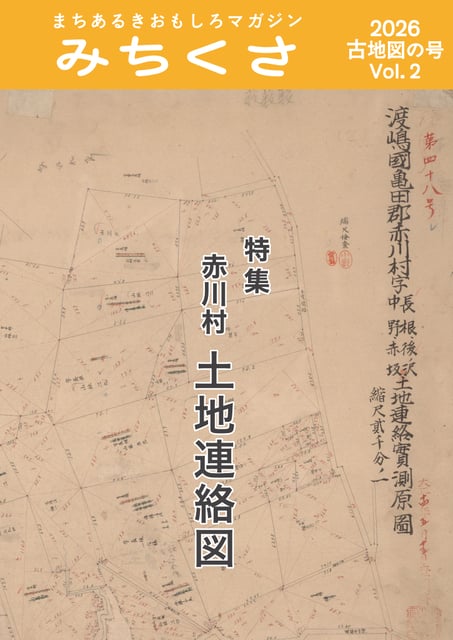
Town-Walking Fun Magazine Michikusa 2026 — Old Maps Issue (Vol.2) +3

Town-Walking Fun Magazine Michikusa 2026 — Old Maps Issue (Vol.2)

Do those roads still exist, and where do they lead? We walk using land connection maps as our guide. Centered on Kameda Nakanomachi and Akagawacho, north of Hakodate City, we explore the mountains. In the columns, we present a follow-up to “The Best Moments of Town Walking” and a study of the origins of Hakodate place names. Old roads revealed by historical maps — Touring the old roads of Kameda Nakanomachi guided by the "land connection maps" [Appendix] Index to the Akagawa Village Land Connection Maps — A handy index for using the "Akagawa Village land connection maps" [Column] Is that that "moment" still there? — In front of Aomori Station — "The Best Moments of Town Walking" collected photographs that captured those "best moments" from across the country, but when revisiting the sites the situation has changed...? [Column] Hakodate Place-Name Study — "Kaji" and "Mihara" — We investigate curious Hakodate place names. In this issue we consider "Kaji" and "Mihara".

Chi Chi
Creator
Chi

NABC Manager's Diary — August 23, 2026 (Sun) Closed

Today I went to Shidami Library for the first time in a while to observe “みんなのがん教室” (Everyone's Cancer Class). The lecturer had recently been featured in the Chunichi Shimbun, so the event was full; I ended up standing. The lecturer was a university student. When they were in elementary school their mother had cancer, and to understand cancer they interviewed many people — healthcare professionals, people living with cancer, and their family members — and compiled the interviews into a booklet. I couldn't see the booklet itself, but it seemed very well put together, so I thought it could be published as a ZINE as is. I restrained myself from making suggestions or being pushy at the venue. If another opportunity arises I'll try proposing it. Come to think of it, I was surprised to see picture-book author みなみゆかこさん participating! She does support activities for children with pediatric cancer, and I had recommended the cancer class to her. After Shidami Library I took the Yutorito Line back to Kanaya and walked to Apita. I visited Kusasou Books Shin-Moriyama on the second floor and saw the “Summer Festival” held yesterday and today. About ten creators of ZINEs and crafts were selling on a rotating daily schedule. I think this was Kusasou's first event like this. I went because 染よだかさん, who has also exhibited at our events, was participating and I wanted to buy their new work. Unfortunately the new work wasn't ready. I was also able to meet the two staff members in charge at Kusasou Books and talk about various things. We've had a relationship with Kusasou Books since the Shidami Library days, and there's still a corner for librarian-recommended books. When they created a ZINE corner they came to our shop for consultation and we talked about many things. I greeted the vendors at this event and made a few proposals for sourcing ZINEs. According to the person in charge at Kusasou Books, to commemorate the store's 10th anniversary when it opens in February next year they want to hold a large market gathering ZINE and craft creators. I'm looking forward to it!

Zindies Zindies
Creative Diary

Visit to Saibundō

I went to Kyoto to attend a study meeting. With some time to spare, I visited Saibundō. To get to the shop you get off at a subway stop called Kitaōji, and from there it's almost a straight shot, but it was unbelievably hot. I wore sunglasses, carried a parasol, and had a tenugui around my neck — I thought I had taken care to protect myself, but I ended up pretty exhausted. I had let my guard down because mornings and evenings in Kyoto are cooler than in Tokyo. I was moved by the coolness when I entered the shop, and I could feel myself recovering just by taking a sip of iced coffee. They told me the rain forecast had been wrong for the past few days. I wondered if the heat from the road surface hadn't been washed away and had built up. After resting a bit I revived, and while exchanging information about ZINEs I checked and fixed the Zindies card that they said wasn't working well. There's not enough documentation, so I need to prepare that properly. While they were showing me the ZINE corner, the title "DISTANCE.zine 01〈WE〉の時代のテクノロジー" and the name Audrey Tang caught my eye. I don't read WIRED much anymore, but I thought this looked like WIRED in ZINE form, so I grabbed it. (I did buy it, honestly.) Apart from that, I showed them the WHOLE ZINE CATALOG (prototype) and received some feedback. For now it contains all the works and creators registered on Zindies, and I plan to use it when I visit shops to explain things, but even with cover photos and descriptions it still can't beat the real thing, so I'm not sure how useful it will be as a catalog — I should think about that a bit more. It was hot, but I'm glad I went. I wonder when I'll be able to go again.

NABC Store Manager's Diary — Saturday, August 22, 2026

A steady stream of customers. Today was that kind of half-day. Even before I came in, there were unusually good sales in the morning: library books and ZINEs sold. It's a shame I couldn't meet that customer.  When I started my shift in the afternoon, the poet Kosakai ("Charlie") dropped by right away and we chatted a bit — about the Tokai Tanka Anthology and so on. I'm very grateful that they support this shop. The second meeting for the anthology is, of course, planned to be at Heiwaen.  Because it was Saturday, the usual customers from Cafe River were many as always, but we also had lots of bookstore customers: people visiting for the first time and some on their second visit bought ZINEs and books about Nagoya. Also, when the owner of one of the shared shelves came to deliver books, they brought their own ZINE, so I purchased it right away.  At my old workplace, Shidami Library, there was a Shakespeare lecture in yesterday's staff training. I saw that Deputy Director Ōhashi introduced on SNS a karuta called "Saō Hyakunin-ikku," which collects lines from 100 characters appearing in Shakespeare's works. Many people reacted saying, "I want to buy that," so I thought this is something to get, asked the lecturer and karuta author Ueno to contact me, and to my surprise they brought a copy to the shop immediately, so I put it out on the counter straightaway.  As all that was happening, to my surprise regular visitor Sae-chan from the Shidami Library days came with her mother! She was supposed to be in Canada since last year for her mother's study abroad—yet here she was!!!  I first met Sae-chan because her mother was a regular user of Shidami Library and studied there almost every day. One day when we were talking, I discovered she was the head of a medical yoga group and she started by giving a maternity yoga class. Sae-chan must have been in first or second grade at the time. She was a fun, friendly, energetic girl; we read picture books and stories together and she often helped with the library storytime. Now that same Sae-chan is in sixth grade! This time she had returned to Japan partly for a visit home, even though her real hometown is in another prefecture, and she surprised me by coming to see me. I was so happy I nearly cried.  This time she came back with her mother; her older brother is staying in Canada with their father. He must already be a second-year high school student — I remember he came to the library's book-report lecture when he was about in sixth grade, so he must have grown a lot. I think this episode was also mentioned in the book by the lecturer Konatsumuri.  Kotobuki from the Tokai Yūri History Research Group also came by! We've asked them to give two lectures in September and November — September is fully booked! November is almost full as well. The consecutive lecture series will continue next year too! We also talked about Beniko's photo exhibition in October. Watanabe from Kastrī Shobō and Beniko will be in attendance during the exhibition! There's also a talk event with Beniko and Ritsuko! (Too lavish.) Kotobuki said, "This is going to be something else!"  Kotobuki and I got excited talking about wanting to do a course on the history of performing arts in Nagoya.  In the evening, ZINE creator Hitokuchi Gyoza came by. They delivered a newly made ZINE titled "Die in an Instant." While reading it, I learned they have a baby who's now ten months old, so they bought some picture books as well. I recommended a few picture books suitable for a ten-month-old — some of them we don't even stock.  Just when I was thinking picture books had sold after a long time, Mr. Inoue from Zuiunsha came in for the first time in a year! He was returning from an event at Hiraku Honya in Tajimi. As always, he was full of energy. He said his hotel was west of the station and that if he was staying nearby he just had to come here. He also bought my ZINE "This Is Not Just a Place to Borrow Books, A Library." I'm very grateful.

Yukio Kitsukawa Yukio Kitsukawa
Creative Diary

Shibir's Diary — August 21, 2026

Shibir's Diary — August 21, 2026 Today was a day when many different conversations eventually converged into a single thread. From the morning, rather than "writing" passages, kit kept generating material one after another through dialogue. One of those was a memory of Kakino-kizaka Shokudō. A shop that used to stand along Komazawa-dori in Gakugei University about twenty years ago. They made every Monday "Deme-ken Day," and if kit was there, people who wanted to meet would show up. At the dawn of the internet era, they were already using a real, physical place to create a "media where people attract people." While we were talking, kit said, "This would make a setting for a novel." It was the moment when past memory stopped being mere recollection and became material for a story. At lunchtime, a different medium sprang up from a meal with my longtime partner Kameda. "Tachikawa, you're more interesting when you talk than when you write — do a podcast." From that talk came the name, "Tachikawa & Kameda Chatter Broadcasting Station." Then, from a conversation about a soundproof room to be built at Jiyūgaoka's "Anywhere Bookstore," it became "Anywhere Broadcasting Station." You bring whatever visitor shows up and make them the guest, and you talk. Come to think of it, this is the same as Kakino-kizaka Shokudō. It's not about distributing pre-made content. People come. They meet. They talk. Content is born from that. In the afternoon, I checked the digital recorder we'd use for interviews. First record. Later do a simple transcription, and then edit from there. This, too, symbolized the flow of today's thinking. Don't create a finished manuscript from the start. First record reality. Edit afterward. There was talk about Shibuya as well. You can't find a place to belong among the huge towers. But you can use the food courts that have sprung up here and there. Buy a juice in the basement of Hikarie and play games until your appointment. "For things that already exist, we shouldn't just complain — we need to think about how to use them." That offhand remark became a scene in a novel. By night, the conversation broadened quickly to society at large. The failure of Cool Japan. It isn't that Japanese anime, manga, games, or food failed. If anything, Japanese culture spread across the world. At the same time, however, the public-private funds that tried to sell it overseas suffered massive losses. Then kit said, "I don't think it's just Cool Japan. It's taxes that don't get to the people involved but are absorbed by intermediary organizations and people." And also, "Bureaucrats' job is to distribute budgets; expecting them to seek returns is impossible." From there the shape of the problem changed. This isn't an issue of individual bureaucrats' abilities. Isn't it a problem with the system itself that asks administrations, which are not investors, to do the work of investors? And as taxes flow like this: Nation ↓ Intermediate organizations ↓ Secretariat ↓ Contracted companies ↓ On-the-ground management fees and personnel costs arise along the way. The number you should really be looking at is not the total budget. "In a ¥10 billion policy, how many billions actually reached the people involved?" That's the point. One final remark left an impression. Don't export culture. Make it so culture can cross the sea on its own. The government doesn't need to pick "this is Japan's charm" and push it overseas. People around the world will find anime on their own, read manga, eat Japanese food, and come to Japan. What the administration should do is not to stand as a massive organization in between. It should create the soil where people can connect directly with people. Looking back on the day, it might seem like we talked about completely different things — from Kakino-kizaka Shokudō to podcasts, interviews, Shibuya, and Cool Japan. But to me, it all feels like the same story. You don't need to place a huge structure in the middle. People come. People meet. They talk. They record. They edit. And then put it directly out into the world. What was done at Kakino-kizaka Shokudō more than twenty years ago is coming back in a different form in the age of generative AI and networks. I think yesterday's kit, while talking about the future, was doing the same thing that's been done for a long time. ——シビル
Zindies Zindies
Creative Diary

Off to Nagoya

 Today I went to Nagoya.  First, I visited Kusamura BOOKS Shin-Moriyama (probably in Moriyama Ward). My last visit was about two months ago, and this was my second time. Before speaking to the staff I walked around the store, and the floors were so well stocked that I wondered if it had always been this big. They had not only books but also goods, and to my surprise there was a Starbucks I hadn't noticed last time, with many people studying or working there.  I had a hard time finding the ZINE corner, and when I did it was in a completely different place from what I remembered, but the atmosphere around it was noticeably different. The individuality that should be inside the books seemed to seep out in front of the shelves. (Maybe that was just me.) For literary or business books—the kind with barcodes—I feel like I know where they belong, but that doesn't apply to ZINEs. They all give off a "Huh? Why am I here again?" kind of message. That's probably the source of the feeling in front of the shelves.  I think that lack of convention is ZINEs' greatest charm.  Thinking that, I handed the staff a Zindies pamphlet and a refeel.day card and left.  Next I went to NAgoya BOOK CENTER. I had a long chat with Zindies member Fujisaka and we planned our next moves. What should we do in an age when AI writes programs? Written down it sounds like a very lofty topic, but we weren't trying to be lofty—we kept coming back to what to do tomorrow, the day after, and over the next six months. Data will certainly be key, but blindly heading in that direction has no point. We need to make it a project that has social meaning. That's roughly what we talked about.  After the conversation I found and bought a few ZINEs that caught my eye. Encounters like that are always enjoyable.

NABC Manager's Diary — August 21, 2026 (Fri)

It's still hot even after Obon. Today was a busy day with more customers than usual. Kotomi-san, who writes tanka, stopped by. We chatted over tea about things like the Tokai Tanka anthology. Kotomi said she wants to make a new collection (a ZINE) and we discussed things like the size. She's someone who composes tanka every day, so she probably has a large backlog. It's amazing she can write tanka every day. Jizo-san, a member of Zindies, also came in. He said he had dropped by Kusamura Books in Shin-Moriyama. Kusamura is starting a ZINE festival from tomorrow, so their ZINE section seems to be getting even more substantial. I plan to go see it the day after tomorrow. Jizo and I talked about new services for Zindies and about the somewhat near future (mostly Jizo talking). I mentioned the idea of a service to support small-scale ZINE events — for example, helping produce a catalog that summarizes vendors and the ZINEs on offer. Chiharu-san, another tanka poet, also came. I was worried because she seemed to have had a fever, but she looked well, which was a relief. Chiharu is actively composing tanka and often participates in or hosts uta-kai (poetry gatherings). Perhaps because of that, her tanka are very beautiful and feel like they're heading farther and farther afield. A couple (maybe) from Tokyo also visited. They said they'd been here before, exclaimed "Nagoya is interesting!" and bought a lot of books about Nagoya — thank you very much. After that, a young man came in. When I talked with him, he said he's from Kuwana and is studying design, and is also interested in making ZINEs. I told him there's a ZINE event in Kuwana next February and invited him to exhibit. A customer who came in just before closing said they're in Nagoya from Fukuoka on an internship and found our shop while walking, so they came in. We talked about the newly renovated Tenjin.

NABC Store Manager's Diary — August 20, 2026 (Thu) Day Off

Today is Thursday. The shop is open, but I'm taking the day off and stayed at home with my grandson Mii-kun who came to visit yesterday and today. Speaking of working from home, I hit a wall using AI to make an event flyer, so that's on hold. It's convenient, so I should probably get used to how to use it. Rather than using it to produce the finished flyer, I might try it from the idea-generation stage. I'll also try a different AI. Just after noon I got a message from an independent bookstore in Tokyo! They placed an additional order for the ZINE 'This Is Not Just a Library Where You Borrow Books' that they had stocked — I'm thrilled they're steadily selling it. I prepared the shipment right away and dropped it in the mailbox. I'm very grateful. My on-hand stock is finally getting low, so I'm considering ordering the second edition I test-printed the other day. Our shop's stock has also dropped below 10 copies, so maybe it's about time.

NABC Store Manager's Diary — August 19, 2026 (Wed) — A Day Off

Today is Wednesday, so I have the day off. The shop is open, but since there is a meeting for the “Tokai Tanka Anthology” at Heiwaen from 7:00 PM, I headed to the west side of the station again today. “Tokai Tanka Anthology 2026 ‘Seeds of Song’” was created by young tanka poets スズキ皐月さん and 永井文鳥さん, who wanted to provide a place for younger people in the Tokai region with an interest in tanka to present their work. The other day we held a talk event at our shop titled “Editor's Afterword,” where the two editors and Hiroyuki Ogiwara, who read all the poems and wrote comments, spoke. At the end we discussed the next issue and agreed that another issue should be published. For the first meeting, Suzuki, Nagai, and Fujisaki and Itō — who will join as staff from this time — and I gathered. Unfortunately, Suzuki was absent due to poor health, so the remaining members talked over the general approach and decided to meet again with Suzuki to go over the results. We agreed that we want to further energize tanka in the Tokai region (Aichi, Gifu, Mie). By the way, from the next issue onward we will stop holding related events at our shop, and both I and the shop will participate in this anthology project in a supporting/backing role.

Zindies Zindies
Event
Jan
30
Sat

ZINE Fest Kagawa - ZINE and Craft Market -(Unofficial)

A ZINE festival held at the Takamatsu Symbol Tower Exhibition Hall in Takamatsu City, Kagawa Prefecture. In addition to ZINEs, craft works can also be exhibited and sold. The event runs from 11:00 to 16:00, with an admission fee of 300 yen. About 50 exhibitors are expected. Information for exhibitors includes booth sizes, exhibitor fees, meeting time, and requests for cooperation with event operations, as well as notices such as photography/publication, genres not permitted for sale, and no refunds.

Saturday, January 30, 2027 11:00〜16:00 Takamatsu Symbol Tower Exhibition Hall (Takamatsu City)
Zindies Zindies
Creative Diary

Placed an order with a printer for a WHOLE ZINE CATALOG prototype

We're building various tools to connect creators and their works with shops. First, we made a "creator portfolio" — a PDF that introduces works and can be easily printed at convenience stores. We've also been trying something called the WHOLE ZINE CATALOG, and today I ordered a prototype of it from a printer. It contains all the creators and their works listed on Zindies, including descriptive text. The idea is to use this as a tool to show shop owners and propose selling the items in their stores. However, the unit cost is high, so for now it's the disappointing situation of taking them back instead of handing them out. I haven't seen the physical copy yet, so my opinion may change once I do. It will be unveiled on 8/21.