Akiko Fujita
Creator
Akiko Fujita
I engage in various activities to help people feel reassured without relying solely on medical care.
There are no one-day events today.
I engage in various activities to help people feel reassured without relying solely on medical care.
 Zindies
Pages for stores registered on Zindies have a 'Contact' button. It was designed for creators to get in touch with stores. If we could also put this button on stores' social media accounts, creators wouldn't have to go to the Zindies site, which would be convenient. Because a 'button' is limited to web pages, we first created a URL-only version. You can simply add the link to an SNS profile or a post. Creators still need to register to actually make contact, but we've made registration simple so you can sign up with just your name and leave things like profile images for later. If you're already registered as a creator, you can contact stores right away. Because these are private communications, the operations team cannot view exchanges in the contact notes; however, we do track only the number of interactions across the service. That figure is an important metric for whether Zindies is effectively connecting creators and stores. Putting that operational stance aside, we want to continue reaching out to creators and stores where they are from the service side.
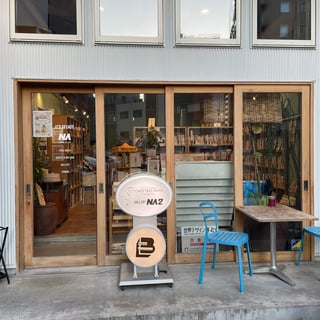 ナゴヤブックセンター
Today and tomorrow are holidays, but because the gallery is holding a photo exhibition by red-light-district photographer Beniko, the bookstore section is open as well. It's short hours, though — we opened to match the exhibition schedule, from 12:00 to 19:00. Even so, my shift ended up being a bit longer than usual. This morning, before the exhibition opened, there was a walking tour around the site of the Nakamura Yūkaku, and after that Beniko and the others came to the shop so we opened just in time at noon. It wasn't as crowded as yesterday, but customers kept coming in all the way through the evening aiming for the exhibition. There were a lot of female fans who said things like "I'm so glad you held the show in Nagoya!" Many people met Beniko and left with happy faces. One customer even asked me directly, "How did it come about that the exhibition is held at this shop?" — I'm glad local fans in Nagoya were so pleased. Not only fans from Nagoya and Aichi, but two different customers came from Chiba Prefecture. One couldn't make it to the Tokyo exhibition, and the other is such a devoted fan that they'll go anywhere in the country if there's an exhibition, whether in Tokyo or Nagoya. There were also visitors from Shizuoka and northern Gifu. Since Cafe Kissa River was closed today, the bookselling floor was relatively quiet, but sales were fairly good. One customer bought all four of Ritsuko's zines (she's appearing at the talk event on the 17th), and others bought books related to the yūkaku and the west side of the station — and as a kind of souvenir? they also bought our shop's can badges. Around 3:00 pm, Chikura, a Zindies member and developer, dropped by. He was hard to pull away from the register, so we couldn't talk at length, but we discussed ideas to make the shop more appealing to use and to increase the number of shop registrations. By the way, a picture book that rarely sells usually has been selling — one yesterday and one today (one is on hold). The title was The Elephant Train Arrived. It was really surprising to sell two copies of the same picture book in a row; that's very rare in our store. This book was introduced in the Chunichi Shimbun not long ago, so perhaps someone who read that article bought it. I'm glad we had stocked two copies. I had thought it might take a year to sell. A young woman who visited the other day came back. Last time I invited her to a Keigo Higashino reading group, and she bought the first volume of the assigned book The Swan and the Bat; today she said she'd finished the first volume and came to buy the second. I'm grateful. She also got to see the gallery exhibition. I'd be happy if she joined the Higashino reading group. A regular customer who works at the local library and is interested in yūkaku research also visited. She highly recommended and purchased a copy of Dr. Akiko Fujita's new book Warm Words Change the World that we had just stocked yesterday. I hope we can arrange some kind of event with the author's local library. While talking with a customer who came from Gifu for the exhibition, I learned that Jun Ikeido is also from Gifu. I had no idea! According to the customer, he may be from Yaotsu Town in Kamo District. I immediately ordered the talked-about book — I wonder if it will sell. I hope it does. Since the number of visitors to the second floor was many times the usual today, I'll clean the stairs after closing when I have time and then head home.
ナゴヤブックセンター
Today the photo exhibition by kawaramachi (red-light district) photographer Beniko began. I usually start work at 1:00 PM, but today I pushed myself to arrive at 11:30. There were already a few people in front of the shop waiting for the second-floor gallery to open (12:00–19:00). Just after I arrived early, a customer bought a book. She was a young woman who purchased a ZINE. When I spoke to her, she said she had come to Nagoya from Sapporo for work. She gave me her business card, so I handed her mine. She told me she makes ZINEs with friends. One of the members of their ZINE group is a graduate of Handa High School, so I asked if they could place copies at our shop. It looks like we'll finally connect with ZINE creators in Sapporo. When the second-floor gallery was about to open, I looked outside the shop and—surprisingly—about twenty people were waiting! I called out at exactly 12:00, and they came up the stairs one after another into the exhibition space. The venue filled up in no time. After the flow of visitors to the second floor settled a bit, a doctor who lives in Nakamura-ku and whom I had connected with on SNS yesterday came by. I had asked if we could stock his self-published book, and he brought a copy right away. He turned out to be a friend of Mr. Hikoda, the speaker for the "Minna no Gan Kyoshitsu" (Everyone's Cancer Class) to be held on November 8 at Nakamura Library, Nagoya! How had we not connected until now? I asked why he hadn't come to the Shidami cancer class, and he said, "It's too far!" Indeed, going from Nakamura-ku to Shidami takes more than an hour. Still, I told him it would have been nice if he'd attended at least once. He is the director of Momoyama Clinic in Midori Ward. He is an internist, but he also provides palliative care and works as a yoga instructor, practicing what they call "social prescribing." His first book, Warm Words Change the World, will be displayed in a face-out stack at our shop. It explains how, as a healthcare professional, the power of words can help patients. He also has a middle school child who has recently been carrying out activities at school to communicate the importance of "warm words," so I asked if he and his child could hold a parent-and-child event at our shop. I hope to make that happen around spring break. The mother also bought one of my ZINEs. Today several people bought ZINEs — three copies sold in one day. Amazing. Beniko is present at the exhibition for the entire run, so many fans visited the shop. It was an incredibly deep day. Not only Beniko, but Mr. Watanabe, president of Kastori Shobo, was in attendance all day, and Mr. Hatano from the Tokai Yūri History Research Association (also known as Kotobuki) stayed for a long time. In the morning, Ritsuko, who will appear at the talk event on the 17th, came all the way from Osaka to visit. What a splendid lineup. The four ZINEs released by Ritsuko are being sold on the first-floor sales floor. As the sun was setting, Michelle arrived — she was on her way back from band practice. It was the first time I properly greeted her, so I felt very lucky. She took a photo of the four of us, including visitors who had come from Toyohashi and Toyota. Maybe she'll feature it on her SNS. It was truly an intense day. The exhibition continues tomorrow (Sunday), and the bookstore will be open. I plan to be at the shop by 12:00 when the exhibition starts.
ナゴヤブックセンター
Today I received packages for the first time in a while: back issues and the new issue of Taido Tanka that I ordered the other day. I was notified that they were being carried on X, so I hurriedly ordered the out-of-stock copies. Although it's called a new issue, it looks like it was released around the summer — I missed it, and I'm sorry about that. Issue No. 7 also features many distinguished tanka poets. A truly luxurious volume. In connection with Beniko's photo exhibition starting Saturday, I also stocked books related to the yūkaku (licensed pleasure quarters). Kohaku Bunko's Jigoku no Hangyakusha: A Collection of Yūkaku-Related Works by Takako Matsumura also arrived. I ordered it without knowing much about it, but Matsumura was from Osaka and apparently worked as a shōgi (prostitute) in the Nakamura yūkaku. Afterwards she escaped the yūkaku with companions and became active in the movement to abolish the licensed prostitution system. I think both of the books that arrived today will enrich our store's selection. Please drop by and take a look.
 LINEN AND VELVET Naoko Kobayashi
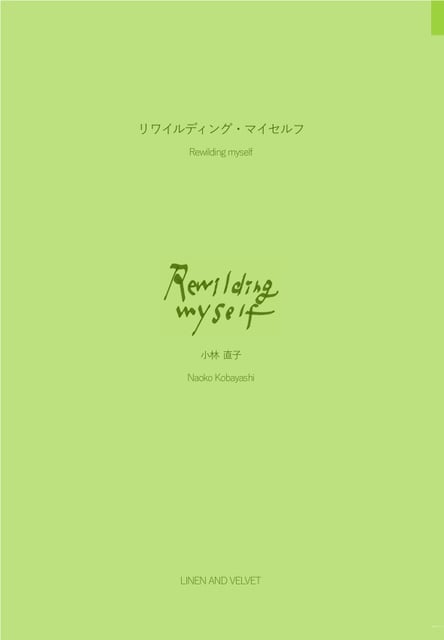
This essay recounts how I nearly died while working at an exploitative apparel company, was told by a doctor, "You may have only three months to live," and how I managed to survive. It is a completely new, previously unpublished work. I hope it reaches people who are suffering in exploitative workplaces.
Zindies
I applied to participate in Bungaku Flea Market Tokyo 44 as the Zindies Project; the event will be held on May 23, 2027. I haven't decided on the content yet — frankly, right now I'm supposed to be fully focused on 43.
 Zindies
Exhibitor applications open from Fri, Oct 9, 2026 at 9:00 PM.
 fako.
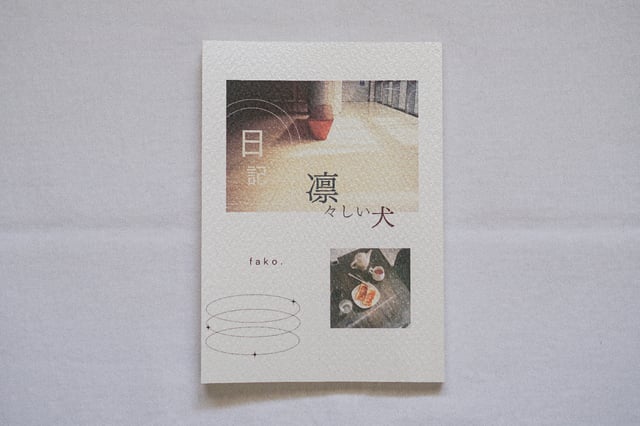 +3
This is a one-year diary that contains my own experience from the beginning to the end of a romance. Uncontrollable joys, painful moments, and things I still don’t want to forget. Slowly swallowing all those days and turning them into the past, so that I can stand while carrying that past. I want to become stronger while remaining vulnerable. Throughout the diary, quotations from books I was reading at the time also appear. I hope it will be a book that makes readers think, “Books are wonderful.” Bunko (pocket) size / 146 pages / perfect binding
fako.

My name is pronounced 'fako.' I like reading, taking photos, and eating (+ Gen Hoshino)! I sometimes write. I'm an analog person who prefers film cameras to digital. I take ordinary photos and jot down small things as I live. Diary — The Gallant Dog is a one-year diary full of my own love, from its beginning to its end. Both the happy moments and the painful ones — so I can stand embracing all of my past. I want to become stronger while still remaining vulnerable.
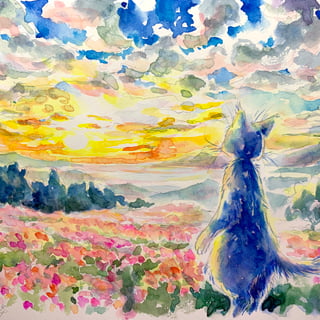 Shino Murakami
 +1
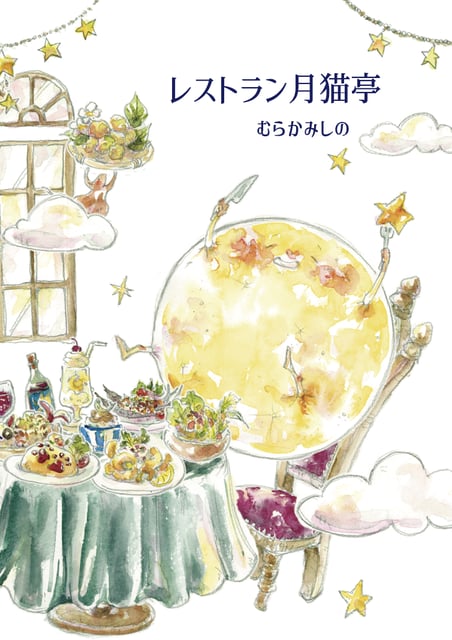
ここはお空の真ん中の ふしぎな不思議なレストラン お腹も心もまんぷくに その名も「レストラン月猫亭」 青い猫のソラは、レストラン月猫亭で働いています。 料理長のネコック、くいしんぼうのお月さまと一緒に、あったかごはんを作るのです。 レストラン月猫亭をめぐる5本のオムニバスストーリー。 ほっこりファンタジックな世界へ、ようこそ。 1.パンケーキたべたいおつきさま 2.ひかりのはらのこだぬきポポ 3.ハッコウハッコウ大作戦! 4.おひさまサンバ 5.ラパンパンパレード 5本のお話が入っています。 お子さまと一緒に読んだり、1人でじっくり味わったり。 オールカラー142ページなので、 イラスト集としても存分にお楽しみいただけます。 歌絵ものがたり作家むらかみしののお届けする やさしい世界。 お楽しみください。
Shino Murakami
 ナゴヤブックセンター
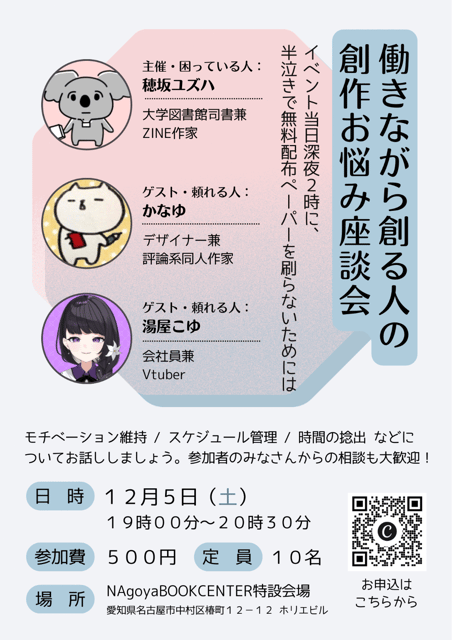
How to avoid frantically printing a free handout at 2:00 AM on the day of the event Yuzuha Hosaka, the organizer (and the one who’s struggling), will host a roundtable with the dependable Kanayu and Koyu Yuya. Let's talk about maintaining motivation, schedule management, and carving out time. Consultations and questions from participants are very welcome!
ナゴヤブックセンター
Before coming to work today I stopped by Fubaisha, a publisher in Osu, and picked up some new releases. I got to the store a little after 2 p.m. Oh — I realized I hadn’t set up the cash register for tonight’s reading-group event, so I arranged that. Since a photo exhibition by the 'irogai' (red-light district) photographer Beniko will open in the second-floor gallery this weekend, I decided to rearrange the books on the display tables. I moved the books about yūkaku (former licensed pleasure districts), which had been on the small table in front of the register, to what you might call the main display table and the face-out display stand, and I moved the Nagoya tanka poetry collections that had been on the main display and face-out stand to the table in front of the register. I think both areas are much easier to browse now. I also moved some ZINEs that had been on the face-out stand a little to the face-out stand by the window (like the magazine racks near the store front) and placed another set inserted into a regular bookshelf. The downside of inserting them spine-in is that many ZINEs don’t have titles on the spines, so it can be hard to tell what’s where. With the number of ZINEs we carry increasing, it’s unavoidable for now, but I’d like to figure something out eventually. After I changed the shelves and registered the books that arrived today, a customer came in right away. She’s a woman who’s been coming in often lately and is interested in yūkaku topics. She’d bought a book about the yūkaku the other day — and today she bought another one. Thank you! In the evening a young woman who looked like a high school student came in. She was looking at the tanka display I’d moved and bought Perspective by Shuta Fujii. When I asked if she was a high school student, she was — it turns out she lives in Chiba and has taken a year off from high school. This summer she worked for a month at a mountain hut in the Central Alps, and she was on her way back; returning to Chiba would cost money, and since she had a holiday coming up she was stopping by Nagoya and taking a night bus to her next destination. I noticed a large backpack in the corner of the store. She was very cheerful and seemed adventurous. She likes writing poetry and has recently become a fan of artists who perform poetry as rap. I thought she was a serious book lover, and since she still had time before her night bus I invited her to join the casual reading group that starts at 7 p.m. Just then the reading-group organizer Tete came in, so I introduced the student. It was a walk-in, but it looked like it would be a fun session. Picture-book author Yukako also joined the reading group. For the theme “a book that changed your life,” of course everyone assumed it would be a book by Noran Nijino. I was on the lower floor and couldn’t participate in everything, but I could hear everyone’s cheerful voices from the second floor from time to time. When I went up to the second floor midway through, the high-school student was introducing a book — Ray Bradbury’s Fahrenheit 451. She’s into SF! I introduced a recent SF short-story collection I enjoyed, In the Town Where the Sunlight Disappeared. This was Tete’s second reading group, and it was another enjoyable meeting, so I asked Tete to run the next one as well. It looks like we can hold it in January.
ナゴヤブックセンター
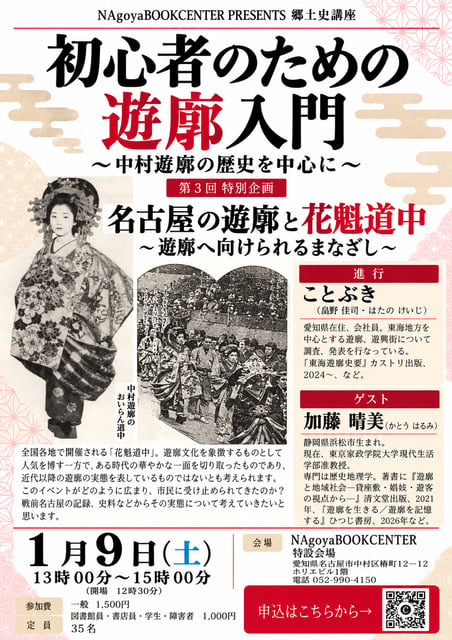
This session is a special program. We will be joined by Harumi Kato, author of "Living the Yukaku / Remembering the Yukaku" (published by Hitsuji Shobo). "Oiran processions" are held across the country. While they have become popular as symbols of yukaku culture, they may simply capture a glamorous aspect of a particular era and not reflect the realities of the yukaku since the modern period. How did this event spread, and how has it been received by the public? We will examine records and sources from prewar Nagoya to consider the actual circumstances.
ナゴヤブックセンター
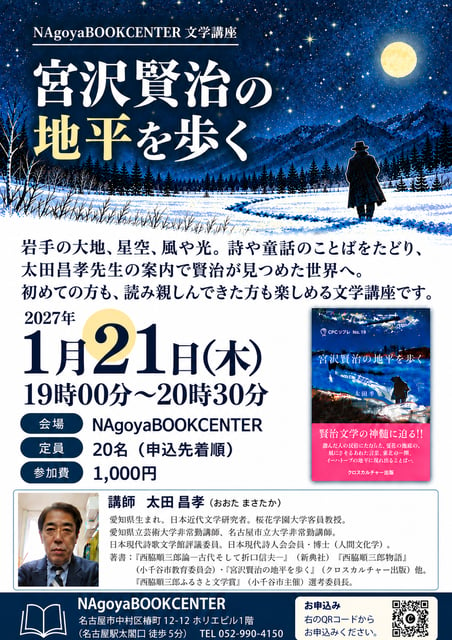
Would you like to walk, now, in the world Kenji Miyazawa once gazed upon? In his poems and children’s tales unfold the land of Iwate, the starry sky, the wind and the light. And the gaze toward the people who live there――. In Miyazawa’s works a distinctive world spreads in which nature and humanity, science and faith, life and death resonate with one another. Guided by Professor Masataka Ota, this literature seminar traces the words of the works and leads to the “horizon” Kenji Miyazawa looked toward. It is a literary course that both longtime readers of Miyazawa and those who would like to start reading him can enjoy.
LINEN AND VELVET Naoko Kobayashi
I've submitted my third zine today — the one I had been preparing for the Bungaku Flea Market Tokyo 43! The title is "Rewilding Myself." It's an essay about how I survived and recovered after nearly being crushed by a 'black' apparel company (an exploitative workplace). The first two zines were excerpts from my blog posts with edits and additions, but the third is all-new, written specifically for this release. I hope it reaches people who nearly suffered at black companies. I'll bring copies to the Bungaku Flea Market in November — please look for me!
Zindies
A market event for ZINEs and craft works. It will be held on February 23, 2027 from 11:00 to 16:00 at the Tokyo Metropolitan Industrial Trade Center Hamamatsucho Hall, 3rd floor. Exhibition booths are 90×90 cm; exhibitors are required to assist with setup, reception, and breakdown as part of event operations. Promotion cooperation plans are available.
Zindies
A market event for zines and craft works. It will be held on August 29, 2027 from 11:00 AM to 4:00 PM at Sanbiru (Iwate Prefectural Industrial Hall), 7th Floor, Large Hall. Exhibitors may sell zines and craft items. Exhibitors are required to cooperate with event operations such as setup, reception, and teardown.
ナゴヤブックセンター
After September's long rains, October has arrived with consistently nice weather as if the wet spell were a lie. Customers finally seem able to go out, and today feels like a busy day at the shop. When I came in for my afternoon shift, some ZINEs had already sold in the morning — off to a good start. The one that sold was AZ's 'Nagoya Bookstore Tour: Northwest Area Edition.' It's a long seller at our store. Perfect for this season. A customer from Iwakura stopped by. The last time I saw them was when we had drinks with members of the Iwakura Library Study Group at a kushikatsu place in front of Nakamura Park a little while ago. She came to drop off two books her mother had written. Her mother apparently worked on social issues in Nakamura-ku; they're local history materials for Nakamura Ward. The daughter herself had recently read the first volume of Tadashi Ota's 'Cafe Utrillo, West of Nagoya Station' and loved it, so she bought volumes 2 through 6 all at once. Thank you very much. A young man came in carrying lots of tanka books to the register and asked, "Do you remember me?" Huh? It turned out to be the high school student who previously bought Haru Mizumachi's 'Lightly Sparkling Tanka'! He'd gotten a bit more grown-up; when I asked, he said he's now a university student living in Yokohama. He'd come to buy Mizumachi Haru's new book 'Only Those Who Cried Alone on the Way Home Feel the Moonlight's Warm Glow,' but our shop is due to stock it next week, so I was very sorry. I told him it would probably be available at bookstores in Yokohama; he said he often returns to Nagoya and will come again. I was moved (tears). He bought a lot of poetry collections. His university doesn't have a tanka club, so I suggested he start one himself.