BeːinG: A Magazine Playing with the Supernatural — Issue 2 "Women and Monsters Dance" +1

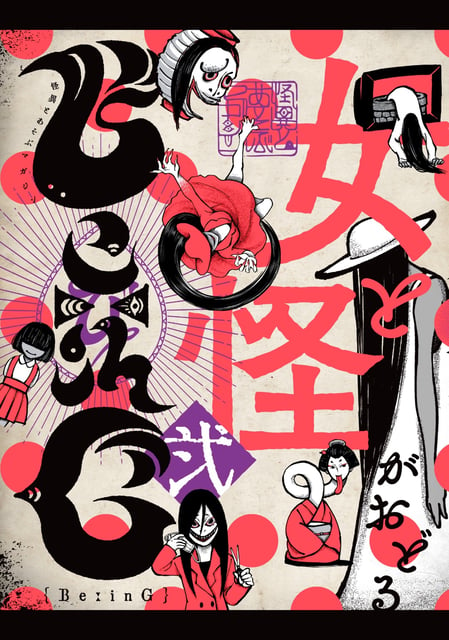
BeːinG: A Magazine Playing with the Supernatural — Issue 2 "Women and Monsters Dance"

BeːinG (BiːinG) — the magazine that plays with the supernatural — returns for its second issue: "Women and Monsters Dance." This issue explores uncanny phenomena related to women. We welcome an even more luxurious lineup of guests than last time. The yokai make-up corner has been powered up with extra supernatural flair! Contents Feature: "Women and Monsters Dance" [GUEST COLUMN] The Lineage of the Cursing Woman — Female Ghosts in Classical Kaidan — Mariko Kawana [INTERVIEW] An interview with Yuki Yoshida about the monster of the Red Woman [ARTICLE] Shocking Confession: "I Encountered the Slit-Mouthed Woman Twice"!!! — Haomari Ko [MAKE-UP PROJECT] The Slit-Mouthed Woman: 7‑Day Mix-and-Match Diary [REPORT] BeːinG Travelogue — A Journey through Women's Mysteries in Okinawa — Naoko Kawakami [GUEST ESSAY] The Comb and the Pregnant Woman — Suisei Kojima [SPECIAL PROGRAM] Women's Ghost Stories: Exchanged Letters — Sakura Fukatsu × Haomari Ko [GUEST NOBEL] Private (For Addressee) — Soichiro Tomoyori [INTERVIEW] Interview with Rie Inoo, who played Sadako in the film "Ring" [COLUMN] The Villainous Women of the Araki Family's Yokai Picture Scrolls — Naoko Kawakami [SERIALIZATION] Haomari Ko's True Ghost Stories "Kiki Kajiri" — The Red Woman: Scene Two [YOKAI ART] Hakutaku — artwork by Nana Yamamoto "Lovable Folks" — Text by Naoko Kawakami & Haomari Ko Yokai Fortune-telling — Readings by Naoko Kawakami

mg. Vol.12: "Around Gyoza"

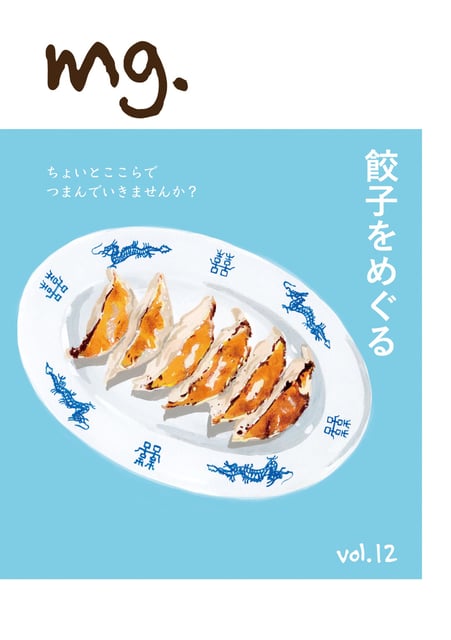
mg. Vol.12: "Around Gyoza"

mg. is a project in which six members ponder a featured food and express it in various forms such as columns, essays, and short stories. The gyoza issue has become like a grown-up's independent research project! Whether you prefer eating gyoza out or making them at home, please enjoy. 【mg. vol.12 contents】 『Around Gyoza』 REPORTAGE Going to eat gyoza. PORCELARTS Cheers at the mg. gyoza tavern! COLUMN Frozen Gyoza Research Notes 2026 Researching various aspects of gyoza A major survey of gyoza (mandu) from our neighboring country, Korea!! GUEST COLUMN Gyoza that appear in films ESSAY Eating on the side COLUMN Try it! Gyoza no Manshu Why are gyoza wrappers round? Guide to store-bought wrappers by type REPORTAGE Gyoza plate hunt in Kappabashi ESSAY Wrapping Communication DIARY Four people's gyoza diary NOVEL Two people's gyoza OSUSUMEGURI What to use for gyoza sauce?

Naoko Kawakami

Naoko Kawakami

While working as a company employee, I create various ZINEs. ZINE editor and writer. I write everything from columns and essays to novels. Main activities - Food-focused ZINE “mg.” (emujī) Produced by six members. A magazine in which each member expresses the theme of food in their own way — essays, columns, fiction, and more. - Magazine that plays with the uncanny “BeːinG” (biīngu) A ZINE produced by the unit BeːinG (Naoko Kawakami & Mariko Hao), who enjoy folklore, yokai, and ghost stories. We pursue strange tales, curious customs, and matters related to yokai. Please feel free to contact me for anything from editing and layout assistance to writing and speaking.

TEXTLiFE TEXTLiFE
Creation
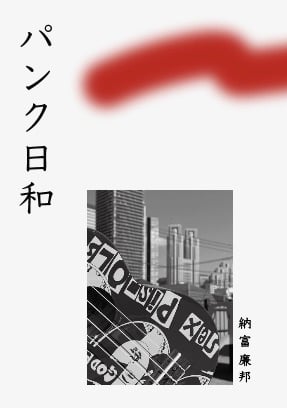
A Fine Day for Punk

A Fine Day for Punk

From New York punk to cyberpunk, whodunit punk (shin-honkaku), and Genroku-era punk inspired by Hanabusa Itchō; from Bunka–Bunsei punk after Katsushika Hokusai, Utagawa Kuniyoshi and Tsuruya Nanboku, to Bakumatsu punk of Aōdō Dazen; from Meiji punk of Tsukioka Yoshitoshi and Toyohara Kiyochika and the shin-hanga punk of Jakurē; through contemporary punk by groups and creators such as Hanagumi Theatre Company, Yuki Shasendo and Denpō Torishima; to SWA’s new rakugo punk, idol punk by BiSH and Sakurazaka46, and even punk for ballpoint pens and toasters — a collection of column fragments that cross the personal and the urban entertainments quietly blooming in back alleys. The table of contents is published as images.

Akio Nakamata Akio Nakamata
Creative Diary

Nice to meet you

I was browsing an SNS when I came across a mention of this service. I wondered whether the books I make are zines (I personally call them “light publications”), so I went ahead and registered the three best-selling titles I’ve released so far. If there are orders, I’ll add a few more titles. My books are mainly literary criticism.

TEXTLiFE TEXTLiFE
Creation
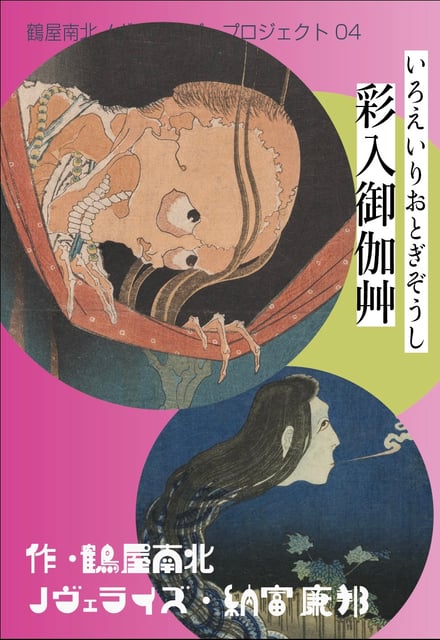
Saiiri Otogigusa — Nanboku Tsuruya Novelization Project 04

Saiiri Otogigusa — Nanboku Tsuruya Novelization Project 04

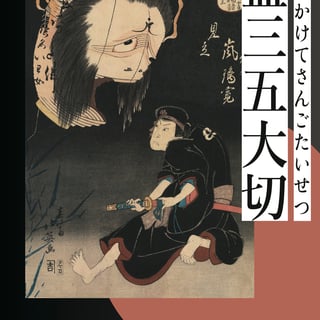
The fourth volume of the Nanboku Tsuruya Novelization Project is finally a ghost-story play, the very genre Nanboku excelled at. Set in Edo and based on two tales that were well known at the time — the undying uncanny “Ki wa Kohiraji” and the plate-counting ghost “Banshū Sarayashiki” — each serves as the basis for a murder case that the young Kikugorō III and Danjūrō VII solve with the aid of ghosts. The original ghost stories that inspired the pieces are also included as short stories, with commentary.

TEXTLiFE TEXTLiFE
Creator
TEXTLiFE
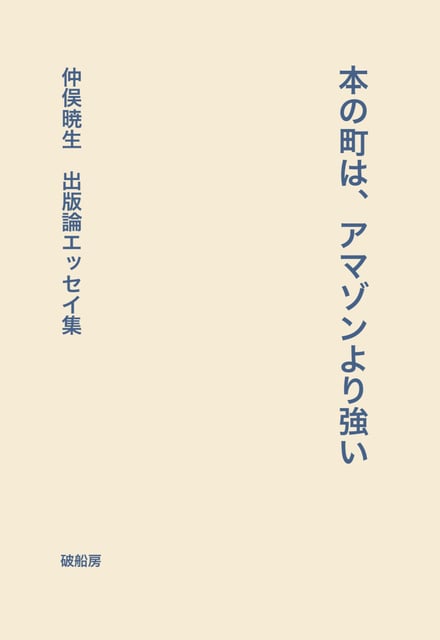
The Town of Books Is Stronger Than Amazon

The Town of Books Is Stronger Than Amazon

A selected collection of essays on “publishing,” “bookstores,” and “media” originally published in the independent web media Magazine Kō and in little magazines during the 2010s through the 2020s, a period when bookstores across Japan continued to decline. It includes episodes from the period that constitute the prehistory of the previously released Monaka to Yokan. A booklet for “people who take action,” full of insights to fundamentally rethink the relationship between books and people. (B6 size, perfect bound, 64 pages)

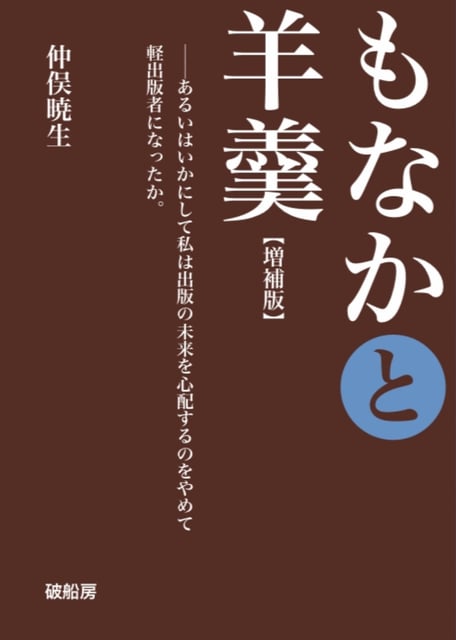
Monaka and Yokan【Expanded Edition】

Monaka and Yokan【Expanded Edition】

The "Monaka and Yokan" released in autumn 2024 has been expanded due to popular demand. This compact volume distills Hasenbo's activities around "the freedom to write" and "the freedom to publish," which began with the "Light Publishing Declaration" in autumn 2023. Why did the author, an editor with 40 years' experience, start "light publishing"? What does that system mean for writers, and how can it actually be put into practice? A practical and emotional "Light Publishing" manifesto!

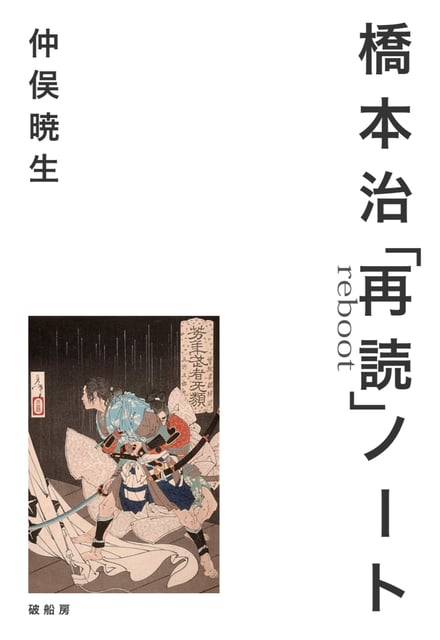
Osamu Hashimoto 'Re-reading' Notes

Osamu Hashimoto 'Re-reading' Notes

This is an exploratory essay that seeks to approach the "thought" of novelist Osamu Hashimoto, who sadly passed away in 2019, by reading and interpreting his critical essays from the mid to late period. Works re-read include The Printed Word Says, 'Rise Up'; Bring the French Revolution to Edo!; Our Modern History; Religion Is Not Scary!; What Was 'Yukio Mishima'?; and The Blessings of Hideo Kobayashi.

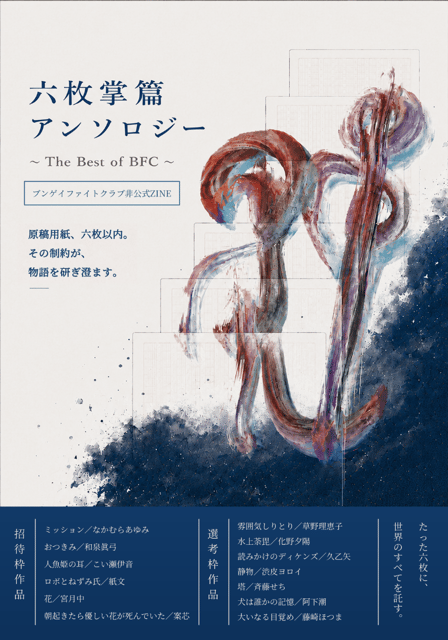
Bungei Fight Club Unofficial ZINE — "Rokumai Shōhen Anthology: The Best of BFC"

Bungei Fight Club Unofficial ZINE — "Rokumai Shōhen Anthology: The Best of BFC"

Cover illustration (figures): Koya Kusano Book design · Editor · Publisher: Shin Oe Contributors (in gojūon order): Ageshio, Yuhi Adashino, Anshin (Shin Oe), Mayumi Izumi, Kamifumi, Rieko Kusano, Hisotsuya, Ion Koise, Sechi Saito, Yoroi Shibukawa, Ayumi Nakamura, Hotsuma Fujisaki, Chuu Miyazuki A6 size · 218 pages ¥1,000 (tax included) · No ISBN

Zindies Zindies
Creative Diary

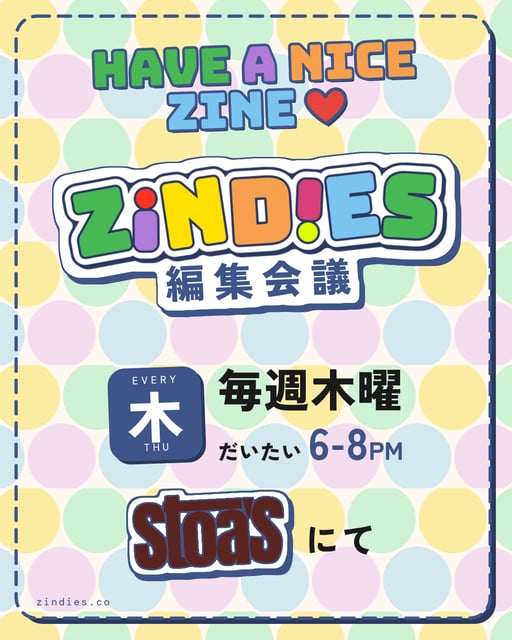
Zindies Editorial Meeting

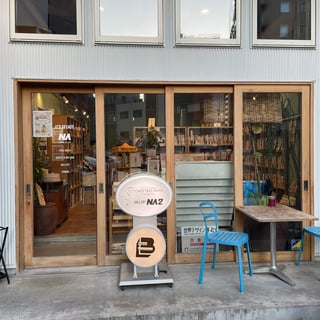
Tokyo has been having a long stretch of rain. It's not a problem as long as I'm staying inside the house, but I still feel like going out. A few days ago I visited a new bookstore called Stoa'S that opened near Jiyugaoka Station. It was still in pre-opening, and the staff were still in training, but I was grateful they were thinking about whether Zindies could be involved. First, we decided we'd like to hold something on a regular basis; the content hasn't been decided yet, but we've settled on the title "Zindies Editorial Meeting." I hope it can become a fun place where all kinds of people come and go.

Event
Zindies Editorial Meeting Vol.0

Zindies Editorial Meeting Vol.0

Topic: 'Thinking about the Zindies editorial meeting' The Zindies Editorial Meeting is a gathering organized by people who create Zindies, held in a corner of a bookstore or a cafe. It's called a 'meeting', but some sessions end as casual conversation. There's almost no agenda, but there will probably be seats. At the editorial meeting we do things like: - Talk about and make decisions regarding Zindies. If you want to collaborate on something, please come. - Consult on how to make and distribute ZINEs. If you want to make one but don't know how, bring your questions; if you already make them, bring a copy you're proud of. You won't be forced to speak. It's fine to come just to watch the people who make Zindies talk. You can arrive and leave partway through. Anyone who comes can call themself a member of the Zindies editorial team from that day (one of the few perks). You can drop in without a reservation, but if you think you'll come, please click the 'Join' button — it makes the organizers happy.

Thursday, October 22, 2026 18:00〜20:00
Zindies Zindies
Event
Apr
11
Sun

The 4th Kagawa Literature Flea Market(Unofficial)

Exhibitor applications open from Oct 2 at 21:00.

Sunday, April 11, 2027 11:00〜16:00 Sunport Takamatsu Symbol Tower Exhibition Hall + Civic Gallery + Communication Plaza (Takamatsu, Kagawa, Japan)

NABC Store Manager's Diary — Saturday, September 26, 2026

Today we had two events, at 2:00 PM and 6:30 PM. Last night, after the evening "Yūnagi" song gathering, I was doing the venue setup, but the 2:00 PM event, "Intro to the Nakamura Yūkaku for Beginners — Session 1," had sold out its 35 seats, so I came in a bit earlier to leave myself some margin since handling registrations alone would be tough. A package from Nippan (book distributor) had arrived; when I opened it, it was the book I had ordered by phone the other day — Hitsuji Shobo's "Living in the Yūkaku / Remembering the Yūkaku" by Harumi Kato! What timing. I'm glad it arrived in time. The lecturer, Kotobuki (SNS name), also arrived; we set up the laptop and projector and checked that the screen displayed correctly, then I went back down to the first floor. After putting the extra copies on the shelf and settling down, participants began to arrive little by little. By the start time I went up to the second floor and it was nearly full. No wonder the register was busy. Because we announced the venue as the second floor, some people occasionally go up the stairs without checking in at the counter. We need to make sure to tell people to register on the first floor in advance. Today the seat count and register sales didn't quite match, but after the session someone who had bought a book also paid their participation fee at the counter, so that was a relief. I proposed this course and asked that the theme be an introduction to the yūkaku. People tend to have fragmentary images of yūkaku but probably haven't learned about them formally, and there aren't many easy-to-read introductory books, so without guidance they often view yūkaku through a kind of retro-romantic lens. I wanted to start from the basics. I think it's wrong to feel a sense of "retro romance" about a system that is part of the sex industry and that monetizes women's sexuality to drive the economy. I hope that learning the history of the Nakamura Yūkaku will provide an opportunity for deeper reflection. As a bookstore manager, I was a bit relieved — the register was as busy as I've ever seen after a lecture, perhaps the best single-day sales for related books. That's all thanks to the lecturer, Kotobuki. Thank you. For the second session on November 28 there were still seats available before today's lecture, but by tonight it's already nearly full. After the course ended, Kotobuki and I discussed plans for a third session. I'll announce the details once they're decided. The other event today, at 6:30 PM, was a lecture to commemorate the publication of Shinichi Ikeo's book "Children on Provisional Release: Targets of 'Japan First'" — Ikeo is an editorial writer for the Tokyo Shimbun. He spoke about the reality and problems faced when children born and raised in Japan who only speak Japanese are suddenly deported with their families to their parents' countries because of their parents' residency status. How should we view the fact that Japan, which has ratified the Convention on the Rights of the Child, is ignoring "the best interests of the child"? The children appearing in this book seem to have their rights neglected. It's not that it doesn't concern us because they are foreign children — friends who were in the same classroom or club yesterday can be suddenly detained by the authorities and put on a plane. That's unbearably cruel. It cannot be said to be in the "best interests" of the child. When I worked as a librarian I provided children's services and worked on multicultural services, but I feel I should have learned more about the situations and challenges faced by foreign-national children who are the targets of those services. Between the two events, the popular tanka poet Soichi Chigusa stopped by the store! I had him sign his new collection "April Zōshi." I spoke with him a little; he said a relative once had a business near the Asahiro brothel in the Nakamura Yūkaku. I'd like to hear more about that story. That said, holding two major events in half a day was exhausting. I'm not as young as I used to be, so I need to think about that a bit more. But I don't want to miss opportunities.