Since the heavy rain the day before yesterday, Nagoya's weather has been unsettled and I feel like we haven't seen the sun for a while. It rained again this afternoon. It wasn't very heavy, which was a relief, but I heard the shinkansen and other trains were delayed.
Despite the weather, quite a few customers came by and I had many conversations.
Picture-book author Yukako Minami, a big fan of Noran Nijino, stopped by the shop while she was in the Meieki (Nagoya Station) area on other business. She even brought me a souvenir! She shared some Nontan gachapon toys that she loves. The shop was quiet, so we went to Kissa River and had a long, leisurely chat. Most of our conversation was about Noran Nijino's work. Since she liked Noran so much, I asked if she would join a reading group. I'll let you know once we set a date.
By the time I had written this it was closing time. I'll continue later.
In the evening, Chikura, a member of Zindies, came by. He stopped in on his way back from Kyoto. He reported that when he presented Zindies at the recent Code4lib, people from libraries didn't seem very interested in zines — only the tech crowd might have been. I encouraged him to try exhibiting at a general fair.
While I was talking with Chikura, two young men came in one after the other. One of them was very interested in zines about yūkaku (the old licensed pleasure quarters) and said, "I don't really have any particular interests right now, but yūkaku sounds interesting, so I might look into it." He didn't seem to know much about what yūkaku were, so I'd be happy if he looked them up.
The other young man was on his way from Hamamatsu to visit his older brother in Hiroshima and stopped by while waiting for a highway bus. He seemed to like bookstores and often goes to Yajimaya at Meiwan. It was unusual and fun to talk with a book-loving young man.
A photo event for ZINE Fest will be held at KIITO Hall (Sannomiya, Kobe). Information for exhibitors is provided, including booth sizes, limits on the number of people, participation fees, and requests for cooperation with setup and takedown. Photos from the event may be posted on official social media channels. Applications to exhibit are accepted via STORES.
Sunday, February 28, 2027 11:00〜16:00
KIITO (Design and Creative Center Kobe), KIITO Hall, Kobe
Today in Nagoya the afternoon brought heavy rain — really at a disaster level. It was reportedly the heaviest downpour on record, and evacuation orders have been issued for almost the entire city of Nagoya due to heavy rain and the risk of river flooding (these orders are still in effect at the time of writing). The area west of the station (Ekinishi), which tends to flood, was at risk, but fortunately our shop did not get inundated.
Despite the heavy rain, quite a few customers came by. A librarian from Tokyo stopped in on their way back from a library event held in Ise yesterday (Code4Lib JAPAN Conference 2025 - Code4Lib JAPANwiki.code4lib.jp) — their return shinkansen was risky, so I had them go back to Nagoya Station quickly — and a local doujin circle, Bungei Chubu, came to deliver back issues. Two copies of my zine 'A Library That's Not Just for Borrowing Books' sold. I'm very grateful.
Also, while talking with a young customer from Toyohashi, I learned they write novels and said they'd like to get their work into book form someday; I suggested making it into a zine as a first step.
In the evening, evacuation orders were issued across the city one after another, and city buses and the subway suspended service on all lines, so I couldn't get home. I bought rice balls and water at a nearby convenience store and decided to stay at the shop until the subway resumed. Judging from the current situation, it might not run until the first trains tomorrow morning. Fortunately the power is still on, so it's not a big problem.
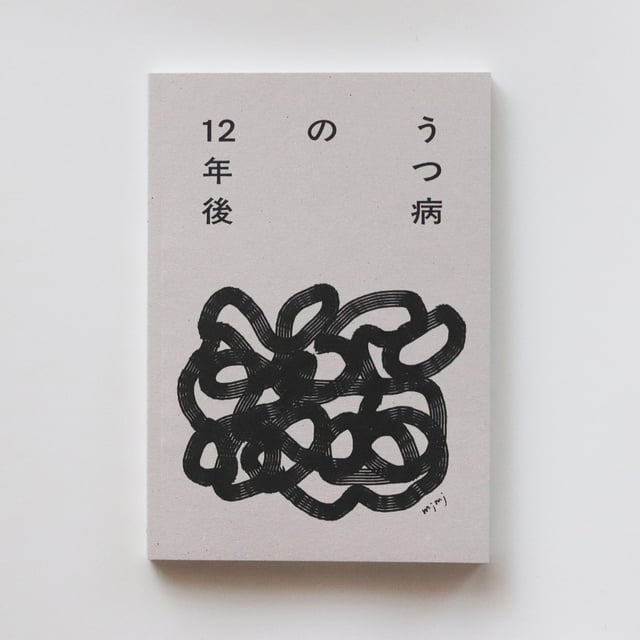
I added footnotes from my present perspective to a ZINE I started 12 years ago, and I wrote about the days that followed.
I fell into depression. I was 28, living alone, working at a design studio. About a year earlier I had moved alone from Tokyo to Kochi. Everything — food, clothing, housing, work, daily life — had been moving in the directions I wanted, and the stress I was aware of had greatly decreased. I was spending calm, enjoyable days, so why did this happen──?
The main text is printed in two colors: blue and brown.
In chapters 1–3 the 12-year-old main text (blue) has footnotes from my current perspective (brown). In chapter 4 I wrote about events that happened after I finished the manuscript 12 years ago (brown).
Includes a reflowable EPUB.
At うたごや we produce accessible ZINEs that let readers choose the way they read. If you buy the print edition of "12 Years After Depression," you can download the reflowable EPUB edition for free.
You can enjoy reading on your e-book reader by adjusting font size and colors.
---
Contents
Preface from two years ago
1. Until I was diagnosed with depression
The door of the psychosomatic clinic / I was cured! / From the antlion pit to the abyss
Column: Why I chose that hospital
2. Acute phase — symptoms of depression
Medication and side effects / White flag! I can't eat! / Is there no night without dawn? / Rumination and self-blame / Decline in thinking ability / Various ailments / Zero motivation / Suicidal ideation
3. Recovery phase — course and rehabilitation
Riding the big and small waves / I could hear music, I could read books / What was it — decline in memory / Getting up in the morning, sleeping at night / Let's take a bath / If I could think "I'll try" / Tidying the room / Library outpatient visits / Impatience and not trusting myself / Counseling experiences / Going to meet people I want to see
Column: Words that made me happy · Words that hurt
Afterword from 12 years ago
4. Memoir — the days that followed
The seesaw of returning to work / Hospitalization in a psychiatric ward / Automatic thoughts and cognitive distortions / Depression and freelancing / The absence of an understanding partner / Life 12 years later (in lieu of an afterword)
Column: Money talk
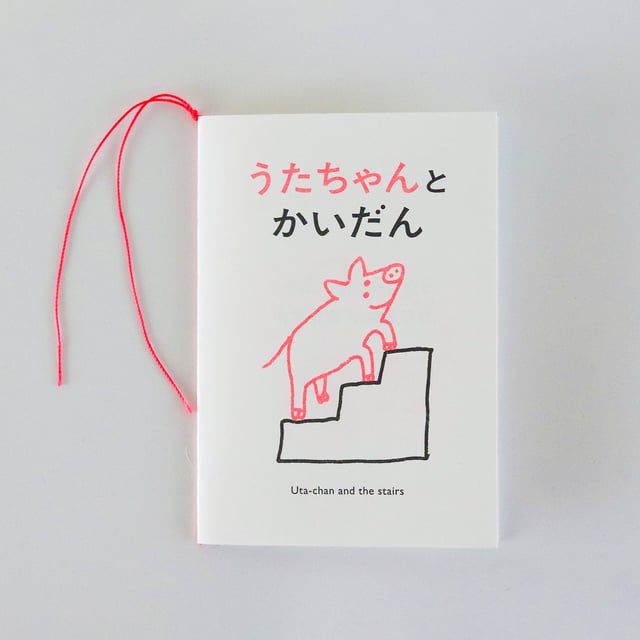
A ZINE like a picture book born from episodes with the mini pig Uta-chan we live with.
By laying a mat on the stairs, the second floor changed for Uta-chan from "a place where she was taken when picked up (something she hated)" to "a place she can choose to spend time in on her own."
The change in Uta-chan's behavior through environmental adjustments seemed to reflect the social model of disability.
Risograph two-color print (fluorescent red + black)
Hand-bound (spine stitched with string)
The digital edition is available at the following page:
https://note.com/mjmjsachi/n/n9b2f530c7b13
A project that explores accessible publishing with various stakeholders such as creators, readers, and supporters.
1. Publishing accessible ZINEs
We produce ZINEs in formats such as print and EPUB so that readers can choose the way of reading that suits them.
2. Creating spaces to get familiar with reading accessibility
We share what we learn about reading accessibility and create opportunities to encounter diverse reading styles.
3. Sharing the exploration process
We publish our trial-and-error learnings from producing ZINEs and organizing events on a note magazine.
produced by majima DESIGN
Today I'm in Ise. I presented about Zindies at the Code4Lib JAPAN 2026 conference held on the campus of Kogakkan University. Code4Lib JAPAN is a long-running initiative in the library × technology space.
The title of my talk was “Building relationships between creators, shops, and readers using a ZINE database.” You can find the presentation materials at the URL below.
zindies.co/articles/code4lib-japan-2026
The gist was that simply building a database of works cannot fully represent the world of ZINEs, and it's important to incorporate the “human connections” that appear there. That may not be surprising to people already using the service. However, for those involved with libraries, many may not know the keyword ZINE, or even if they do, they might feel it has nothing to do with them. Imagining that kind of away situation, I gave the talk trying to rally my courage.
I don't really know how it was received. A few people did show interest and asked questions, so I'm happy if something of it stuck in their memory.
It was a bit far, but I'm glad I went. Ise Jingu (Ise Grand Shrine) was very close by, but unfortunately I didn't have time to sightsee.
Today I'm in Ise. I presented about Zindies at the Code4Lib JAPAN 2026 conference held on the campus of Kogakkan University. Code4Lib JAPAN is a long-running initiative in the library × technology space.
The title of my talk was “Building relationships between creators, shops, and readers using a ZINE database.” You can find the presentation materials at the URL below.
The gist was that simply building a database of works cannot fully represent the world of ZINEs, and it's important to incorporate the “human connections” that appear there. That may not be surprising to people already using the service. However, for those involved with libraries, many may not know the keyword ZINE, or even if they do, they might feel it has nothing to do with them. Imagining that kind of away situation, I gave the talk trying to rally my courage.
I don't really know how it was received. A few people did show interest and asked questions, so I'm happy if something of it stuck in their memory.
It was a bit far, but I'm glad I went. Ise Jingu (Ise Grand Shrine) was very close by, but unfortunately I didn't have time to sightsee.
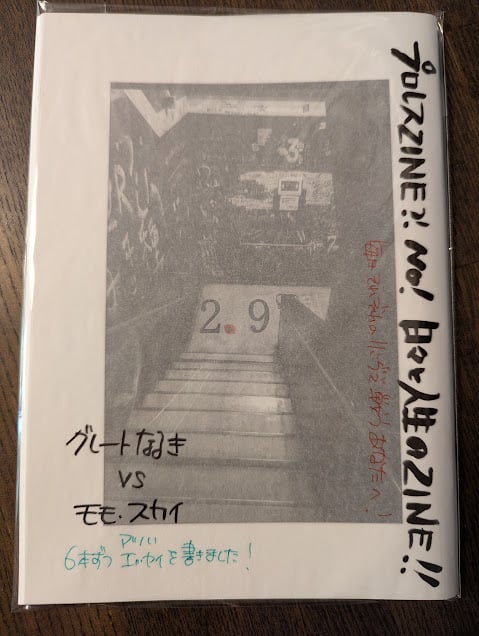
This is not a report or fan commentary.
This is a fiery ZINE where I reflect on my own life, living, and everyday moments alongside pro wrestling — I hit with blunt words, black-history confessions, and honest feelings.
A collaboration/duel/co-creation between Osaka-based writer/essayist Momo and Toyama-based ZINE creator Naruki.
A literary pro-wrestling singles match!
A no-weight-class, no-time-limit, one-fall bout!
It turned into a book that's beyond just "human-ness" — simply, human.
Six essays of about 2,000–3,000 characters each.
So 12 essays total.
38,000 characters, 60 pages. Thick!
It's intentionally a partly hand-written photocopy zine. Hot!
To all the wrestlers who step into the ring,
and to all performers who take the stage — and, of course, to everyone living day by day on the ring of the world theater.
Strength and weakness, beauty and ugliness, steadfastness — on the ring (on stage) things are shown and pulled out, and pulled out of you.
With many, many feelings, and above all with respect, maybe love?
For more details and the feelings behind it, I wrote at length on the following Note and Instagram.
https://note.com/momohanabutai/n/n52d2cbf02aa8
https://www.instagram.com/p/Db78k-lFEA5/?hl=ja&img_index=1
Thank you.
I've always loved stages and theaters,
and I think the world is a theatre where many different people perform together — maybe people are like flowers.
A person who thinks about such things has written about everyday, ordinary life and people in "my words".
In this complicated world — social media, living alongside people who think differently, sympathy and empathy —
I do think about those difficult issues, but I don't write about them.
Still, by writing I want to think, together with someone and with everyone, about "being human" and "living".
To everyone who blooms on their own stage every day.
https://www.instagram.com/p/DLMh6CPvzU2/ (introduction on Instagram)
https://note.com/momohanabutai/n/n1d235fa42fa2 (introduction on note)
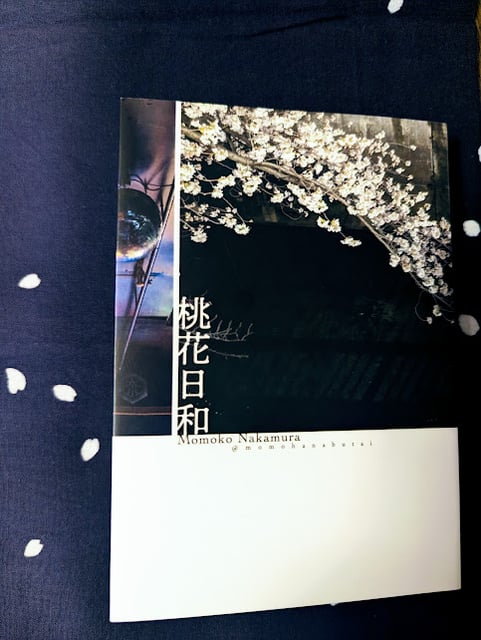
Drawn to places where traveling troupes and popular-theater playhouses, strip theaters, professional wrestling venues, and bars—the kinds of places where you can feel people's heat and smell—she goes there to watch, feel, and write about human "life" and the "now." Based in Osaka.
Fascinated in childhood by musicals and kabuki, she has frequented audiences of large stages, small theaters, yose variety shows, and every genre of live performance. While a student she worked in a theater company as an actor, director, and production staff. After studying under a comedy playwright's private school and working part-time at a theme park, she provided scripts for comedians and idols and wrote interview pieces for indie magazines. She also worked as an assistant director/creative for radio programs and later at a production company/advertising agency. She is now active as a freelance writer, scriptwriter, and essayist.
Her first essay collection, "Momohana Biyori," is now on sale. Shared bookshelves: 2 boxes + α — "Bookstore: Momohana Biyori" (inside Books & Gallery "Shuppatsuten").
note "Momohana Butai" (miscellaneous essays and announcements).
Profile, social links, and a list of contributions:
https://lit.link/momohanabutai
Set in the seas off Nomozaki, Nagasaki, this novel traces the life of a man as he moves from boyhood into adulthood. Love, work, parting, and reunion—.
The story overlays the joys and sorrows of human life on the sight of the “ago” (flying fish) skimming above the sea.
Yesterday I attended an evening meeting in Tokyo and stayed overnight, so today I took the shinkansen from Tokyo Station back to Nagoya. After the meeting, at the social gathering an interesting book came up in conversation, so I stopped by the Maruzen bookstore in Marunouchi before boarding the shinkansen to try to buy it. Search results suggested it was in stock, but I couldn't find it on the shelf and unfortunately left Tokyo Station without buying it. The book in question was "Living the Continuation of That Day" — people said reading it makes you want to talk about it with someone, though whether it's actually good is another matter. Intriguing, right? A conversation you would expect at a gathering of book lovers.
あの日のつづきを生きている - 朝倉宏景|東京創元社tsogen.co.jp
On the shinkansen I had Kiyoken's shumai bento and got into a travel mood; before I knew it we had arrived at Nagoya Station. There's a talk event tonight, so I spent the day at the register preparing flyers and the like. Oh — new arrivals came in.
A new book by popular tanka poet Soichi Chigusa, who is from Nagoya, arrived from the publisher Seijisha: the tanka collection "April Zōshi." The design is stylish and delicate, so we wrapped the copies on display in plastic; I left one unwrapped as a display copy.
I also stocked a new ZINE. Someone I met at a ZINE event made one with their friends, so I took a few copies on consignment. It was their first ZINE and the type is extremely small — at my age I probably can't read it comfortably. If I force myself to read it I'll risk my eyes, but it seems fine for younger readers, so I'll let it be. Still, I'd like them to be a bit more considerate next time. Accessibility for reading is something I'd like to see considered even in the ZINE world.
Just after 5 p.m. people began arriving for tonight's event. Chikura, a member of Zindies, also stopped by. They will be speaking at the Code4Lib JAPAN Conference 2026 at Kogakkan University in Ise starting tomorrow, and they joined tonight's event before that. Coincidentally, the speaker Kazufumi Iida also came by the store, so I introduced them. I wonder if Iida found it interesting.
About 20 people attended Iida's talk. Remarkably, participants had come from Saitama, Tokyo, Kanagawa, Toyama, Kyoto, and of course locally as well. More than half of those attending were from libraries, and there were also bookstore staff among them.
The theme of Iida's talk was "Ten Things People Who Work with Books Should Consider in a World Where 90% Read Few Books." Having spent my life among people who love printed text, I was deeply rooted in the old idea that reading equals reading printed characters, and I had a hard time adapting to younger people's new forms of reading. But it's clear we need to be more flexible in how we think about the act of "reading."
From the floor, a bookseller from Toyama spoke about their shop's "Night Reading" initiative held in the bookstore, and a children's bookshop from Kanagawa talked about online reading groups with mothers. It seems many initiatives are growing in the field.
The afterparty was a small group at a nearby Furaibo. I joined after finishing closing duties at the shop.
During the talk, Iida mentioned that postwar reading-promotion activities originally targeted adults as well, which made me think that it may be somewhat wrong that reading promotion has become focused primarily on children. Reading-promotion efforts aimed at young people have already produced certain effects (even if those forms of reading were unexpected by older generations), and now it seems that promoting reading among adults may be what's needed. For people who don't read books, we should use every means to show that "reading" can be enjoyable. If we can do that, perhaps that's enough.
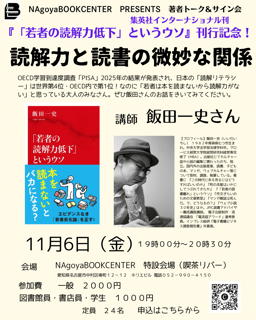
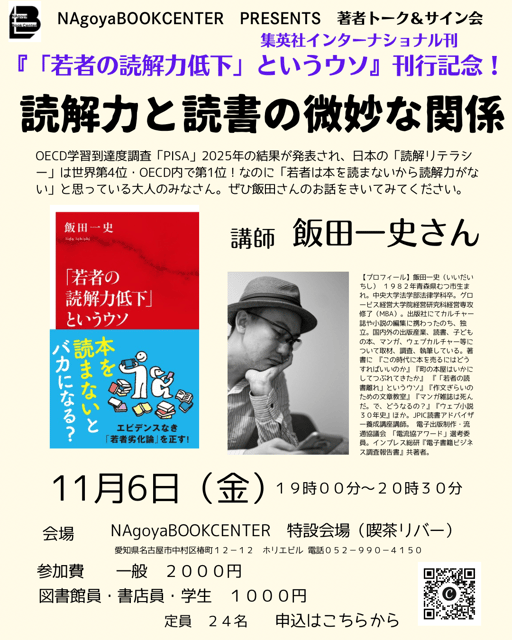
Kazufumi Iida's next talk will be on Friday, November 6, at 19:00.
The theme will be "Reading Comprehension and Its Subtle Relationship with Reading." Stay tuned.
The Subtle Relationship Between Comprehension...
Yesterday I attended an evening meeting in Tokyo and stayed overnight, so today I took the shinkansen from Tokyo Station back to Nagoya. After the meeting, at the social gathering an interesting book came up in conversation, so I stopped by the Maruzen bookstore in Marunouchi before boarding the shinkansen to try to buy it. Search results suggested it was in stock, but I couldn't find it on the shelf and unfortunately left Tokyo Station without buying it. The book in question was "Living the Continuation of That Day" — people said reading it makes you want to talk about it with someone, though whether it's actually good is another matter. Intriguing, right? A conversation you would expect at a gathering of book lovers.
On the shinkansen I had Kiyoken's shumai bento and got into a travel mood; before I knew it we had arrived at Nagoya Station. There's a talk event tonight, so I spent the day at the register preparing flyers and the like. Oh — new arrivals came in.
A new book by popular tanka poet Soichi Chigusa, who is from Nagoya, arrived from the publisher Seijisha: the tanka collection "April Zōshi." The design is stylish and delicate, so we wrapped the copies on display in plastic; I left one unwrapped as a display copy.
I also stocked a new ZINE. Someone I met at a ZINE event made one with their friends, so I took a few copies on consignment. It was their first ZINE and the type is extremely small — at my age I probably can't read it comfortably. If I force myself to read it I'll risk my eyes, but it seems fine for younger readers, so I'll let it be. Still, I'd like them to be a bit more considerate next time. Accessibility for reading is something I'd like to see considered even in the ZINE world.
Just after 5 p.m. people began arriving for tonight's event. Chikura, a member of Zindies, also stopped by. They will be speaking at the Code4Lib JAPAN Conference 2026 at Kogakkan University in Ise starting tomorrow, and they joined tonight's event before that. Coincidentally, the speaker Kazufumi Iida also came by the store, so I introduced them. I wonder if Iida found it interesting.
About 20 people attended Iida's talk. Remarkably, participants had come from Saitama, Tokyo, Kanagawa, Toyama, Kyoto, and of course locally as well. More than half of those attending were from libraries, and there were also bookstore staff among them.
The theme of Iida's talk was "Ten Things People Who Work with Books Should Consider in a World Where 90% Read Few Books." Having spent my life among people who love printed text, I was deeply rooted in the old idea that reading equals reading printed characters, and I had a hard time adapting to younger people's new forms of reading. But it's clear we need to be more flexible in how we think about the act of "reading."
From the floor, a bookseller from Toyama spoke about their shop's "Night Reading" initiative held in the bookstore, and a children's bookshop from Kanagawa talked about online reading groups with mothers. It seems many initiatives are growing in the field.
The afterparty was a small group at a nearby Furaibo. I joined after finishing closing duties at the shop.
During the talk, Iida mentioned that postwar reading-promotion activities originally targeted adults as well, which made me think that it may be somewhat wrong that reading promotion has become focused primarily on children. Reading-promotion efforts aimed at young people have already produced certain effects (even if those forms of reading were unexpected by older generations), and now it seems that promoting reading among adults may be what's needed. For people who don't read books, we should use every means to show that "reading" can be enjoyable. If we can do that, perhaps that's enough.
Kazufumi Iida's next talk will be on Friday, November 6, at 19:00.
The theme will be "Reading Comprehension and Its Subtle Relationship with Reading." Stay tuned.
“I want to make a ZINE but don’t know where to start”
“I feel making an entire book might be a bit too much”
For those people, we wanted to offer an easy way to get into ZINEs by starting from just one page.
A single page inside a ZINE.
On that one page you can pack in whatever you like — the things you love, what you’re thinking about, your everyday life, and more.
Illustration, photography, writing, poetry, collage — the form of expression is up to you.
Whether you have made ZINEs before or never made one, you are welcome to participate.
Would you like to send your one page to someone?
Sunday, December 13, 2026 〜 Saturday, December 26, 2026
Only one week to go.
I'll be participating in Bungaku Flea Market Osaka 14.
Our booth is 'te-81'.
After you enter, turn immediately left and walk straight; we're at the far end of the 'te' row.
Our commitment at events is to actually make and sell the snacks that appear in the books we create.
We operate as a shop offering 'books about snacks and the snacks from those books.'
The books are also handmade to match the image of simple homemade snacks.
Please come and take a look.
We will hold a talk event to celebrate the publication of publishing journalist Kazufumi Iida's new book, 'The Myth of Declining Reading Comprehension Among Young People', published by Shueisha International.
I took the day off today to take care of some errands. My energy still hasn't fully recovered, but I'm slowly getting my body moving.
In the afternoon I took the Shinkansen to Tokyo. I got off at Shin-Yokohama to visit Earth Plaza (Kanagawa Prefectural Center for Global Citizens). A librarian who has been helping me started working this week, so I went to say hello.
In the evening I had a meeting and a social gathering in Tokyo.
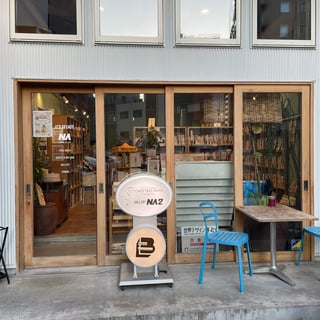 ナゴヤブックセンター